String skipping sounds like the easiest thing in the world: play one string, ignore the next, play the one after. Then you try it and your pick clips the string you swore you would leave alone. Congratulations, you have a very normal picking hand.
This is the troubleshooting version of my full string skipping guide →, where I show two licks from my band Atomic Symphony. Here we look at what usually goes wrong and what tends to fix it.
First, what counts as string skipping?
Applied Guitar Theory defines it simply: consecutively picked notes fall on non-adjacent strings, so you skip at least one string between two picked notes. That is all. Everything below is about doing it cleanly.
Mistake 1: You never watch your picking hand
Guitar teacher Tom Hess describes a student whose string skipping fell apart at higher tempos, and the first problem he noticed was that the student was not watching his own picking motion. You cannot fix a movement you never look at. Watch the pick for a few minutes, ideally while playing slowly. It is humbling, but so is the mirror at the gym.
Mistake 2: The pick never climbs out of the “trench”
Hess says that to avoid hitting the string you want to skip, the pick has to come outside the strings during the skipping motion. He calls the space between the strings “the string trench”: the pick stays in it while you play on one string, and climbs out only when it has to travel to the next one. If your pick takes the direct route through the skipped string, you hear it.
Mistake 3: The motion is far bigger than it needs to be
The opposite problem. Hess notes that string skipping needs a larger motion than neighbouring strings, but the smaller you can keep your picking motion, the easier it is to play fast. Watch the arc your pick makes and keep it as small as you can get away with. The catch: do not shrink it so far that your notes lose articulation.
Mistake 4: You only practise one picking direction
Applied Guitar Theory suggests practising with both inside and outside picking: inside picking means picking on the inside of the two strings, outside picking on the outside. Many of us have a favourite direction and quietly avoid the other. Treat it like flossing: nobody enjoys the weaker side, and that is exactly why it needs the work.
Mistake 5: Speed first, control later
Hess points to two things that hold string skipping back at speed: two-hand synchronisation and excess muscle tension in the picking hand. His point is that hands drift out of sync more easily when the pick skips strings, and a tense hand makes moving between strings harder. Applied Guitar Theory’s answer is plain: use a metronome, start slow, make every note clean, and only then raise the tempo. In my full guide I say the same thing: memorise it, play at about half speed, then speed up gradually.
Today’s takeaway: a five-minute drill
- Pick an open chord shape, as Applied Guitar Theory does, and play its notes on two non-adjacent strings, then on another pair.
- Set the metronome slow enough that every note is clean.
- Do it once with inside picking and once with outside picking.
- Watch your pick hand and keep the motion small but clear of the skipped string.
- Only raise the tempo when it sounds clean.
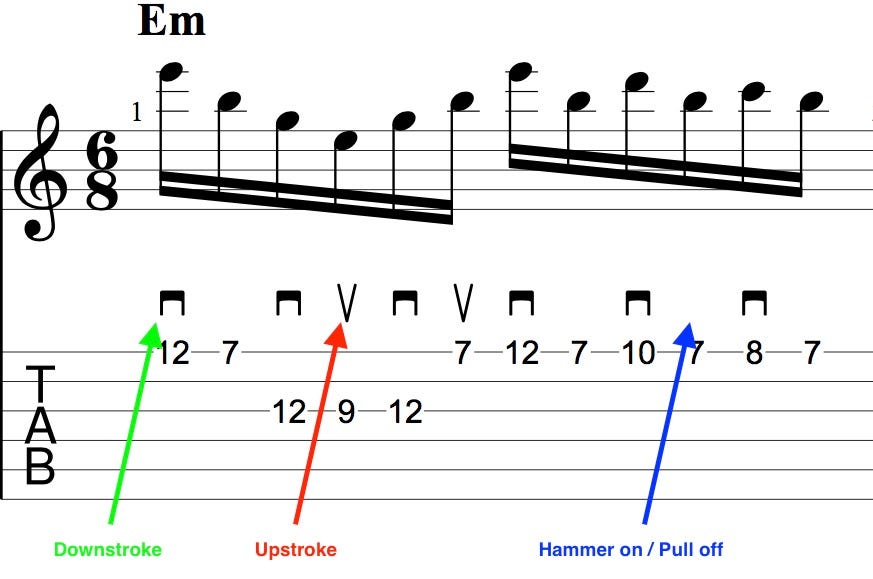
Then take the idea into real music, for example a melodic rhythm with steady eighth notes, and check your downstrokes and upstrokes while you are at it.
Sources: Applied Guitar Theory, String Skipping Exercises for Guitar · Tom Hess, 5 Ways To Play With Faster & Cleaner String Skipping Speed
If this saved your pick from one more wrong string, you can throw a coffee my way on Patreon — no pressure, purely for the riffs.