Easy Twelve Bar Blues
We all know this; you’re sitting with other musicians in the practice room. Person 1 wants to play song 1, but you don’t know it. You want to play song 2, but they don’t know it. Quickly, a musical ‘jam’ turns into sitting around and drinking alcohol.
To avoid this situation to some extent, there are things that everyone should actually know. One of them is the ‘Twelve Bar Blues’.
Twelve Bar Blues
Here, let’s take a look at a very simple version.

For this, we play only 2 strings simultaneously. The open A string (if you’re unsure which string is which, please check here: How to tune a Guitar?) and the D string, which, however, is fretted.
If you have no idea about tabs, take a moment to read this post: How to read Guitar Tabs?
Also, make sure to play phrased in swing or shuffle. If you play the rhythm ‘straight,’ in binary, it may sound like it’s written on the sheet, but not like a blues.
Here are two quick examples:
Audio Example (Binary)
Audio Example (Ternary)
The latter sounds a bit more like blues, doesn’t it? To achieve or communicate this ‘shuffle,’ a simple comment like ‘Swing’ at the top of the sheet music is sufficient. Another option is to use this symbol:
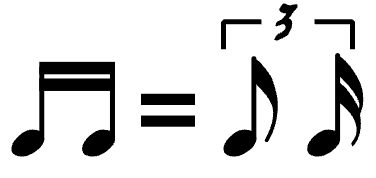
This indicates that ‘normal’ eighth notes are played as a quarter triplet and an eighth triplet. This way, I don’t have to painstakingly write the entire song with these triplets; I can note it once and assume that everyone knows what I mean.
Variation 1

Very important! Make sure the structure is correct. So, play 4 bars of A, then 2 bars of D, and again 2 bars of A, and so on. You can’t just decide to skip a bar or something like that. It might still sound like a song, but not like a Twelve Bar Blues anymore.
One of the most well-known songs that also plays the Twelve Bar Blues is probably “Johnny B. Goode”.
Variation 2

In this variation, the structure remains the same, so we still have 12 bars, with the first 4 being A, the next 2 being D, and so on. However, we add one more note. Instead of playing on the D string for beats 2 & 4, 2 & 4, 2 & 4, 2 & 4, we now play 2 & 4 & 5 & 4…
Variant 3

By far the coolest way to play a Twelve Bar Blues is probably the following.
Here, we play either Variant 1 or Variant 2 (I’ve chosen Variant 2), but we add a short triolic transition at the end of each bar. Also, one bar before transitioning to the D chord, we make a typical bluesy transition. Since this variant is challenging to read, here’s an example:
Putting Variations together
Just because we now have three different variations doesn’t mean you have to play each one separately. You can now mix everything together.
For example, use Variant 1 for bars 1 & 2, Variant 3 for bars 3 & 4, and so on.