A triad only ever has three notes — root, third and fifth — so on paper it looks like there's nothing to memorize. Then someone hands you a chord chart full of slash notation like "C/E" and suddenly it feels like a pop quiz. We've already covered what a triad is and how its inversions are built in full; this is the pocket version for when you just need to name a shape, fast.
The One Rule That Matters
Forget counting intervals. Look at the lowest-sounding note only — that single note tells you the inversion. According to musictheory.net's lesson on triad inversion and the Open Music Theory chapter on inversion, a triad is in root position when its root sits in the bass, first inversion when its third is in the bass, and second inversion when its fifth is in the bass — full stop. It has nothing to do with which notes sit above it.
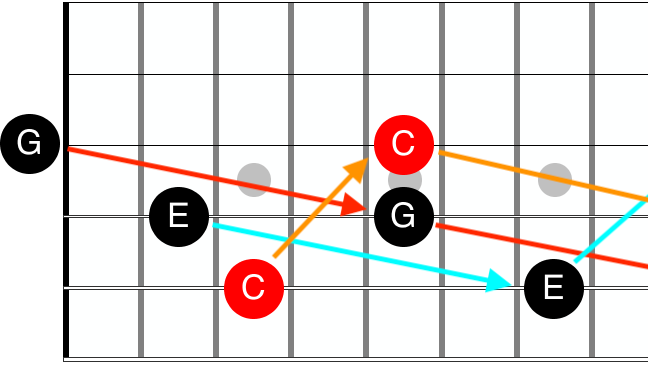
C Major, All Three Ways
| Inversion | Bass note | Notes, low to high |
|---|---|---|
| Root position | C | C–E–G |
| First inversion | E | E–G–C |
| Second inversion | G | G–C–E |
On a three-string set on guitar, that bass note is simply whichever note lands on your lowest string of that set — so on the D–G–B strings, a C major triad played D=E, G=G, B=C is first inversion, because E is the lowest-sounding note of the chord, even though it isn't the lowest-pitched string on the whole instrument.
Why the Order Changes the Sound
Root position stacks two thirds on top of each other and sounds the most "settled". First inversion is a sixth chord shape — a third under a fourth — and second inversion has a fourth under a third, which is why it's often described as the least stable-sounding of the three; that's exactly why classical harmony traditionally treats it as a passing or cadential shape rather than a resting point. If you want the audio examples that demonstrate this difference note-for-note, the full article has them →.
Use It Fast
Next time a chart says "C/E", you now know instantly: that's a C major triad in first inversion, E in the bass. No re-deriving the scale required. Want to see how this connects to full four-note chords on adjacent strings? Check out Drop 2 Chords on Guitar next, or revisit how to play the same chord in different ways for the bigger picture.
If this saved you from squinting at a chart mid-gig, you can toss a coffee my way on Patreon — no pressure, purely for the riffs. Now go tell your bass player what note they're actually playing.