Palm mute accents on guitar: the groove is in what you don't let ring
Play one chord sixteen times in a row, every hit equally loud, equally long, equally everything, and you have built a very expensive metronome. There is no riff yet. The good news: you don't need a second chord to fix that. You need accents.
What an accent actually is
An accent is an emphasis on one note compared with the notes around it. Music theory sorts accents by where the emphasis comes from: a note can stand out because it is louder (a dynamic accent), longer (an agogic accent) or higher in pitch (a tonic accent). Guitarists get a fourth option that feels like cheating: instead of making one note louder, make all the others quieter. That is what palm muting does.
Trick 1: mute everything except the notes that matter
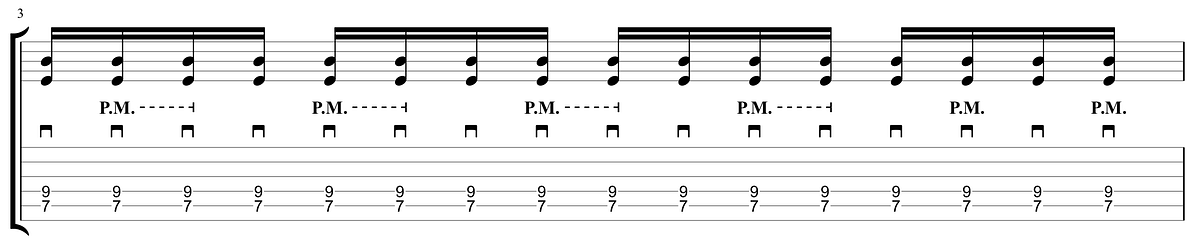
For a palm mute you rest the edge of your picking hand on the strings near the bridge, so the notes sound dampened, tight and percussive instead of ringing out. If every note is muted by the same amount, the riff is still flat, just flat and chunky. The groove starts when you lift the palm on a few chosen notes: they ring open and pop out against the muted ones. Contrast is the whole trick. Position matters too: with the palm too far back nothing changes, too far forward and the notes are muffled beyond recognition, so look for the sweet spot in between.
In my guide on melodic rhythm I play the same E5 power chord over and over and simply leave the palm mute off on the first note, the 4th, the 7th and so on. Nothing else changes, yet suddenly there is a rhythm.
Trick 2: let the pitch do the accenting
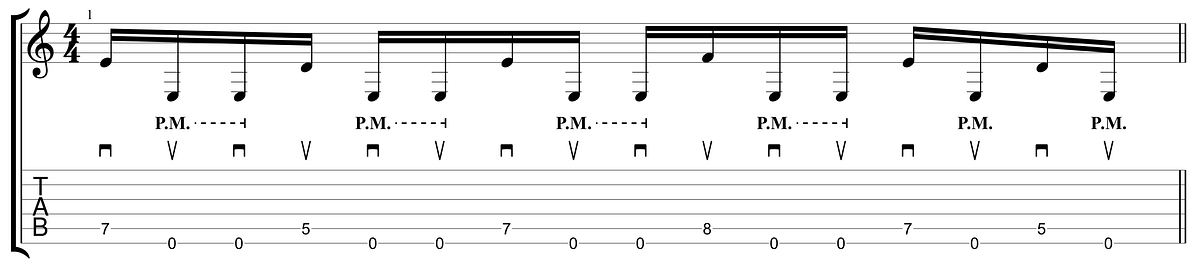
The second tool needs no palm at all. Play a low note again and again and drop in a higher note now and then. A note that sits above its neighbours tends to be heard as an accent, and the ear picks up the higher notes as the rhythm. In my melodic rhythm examples it works exactly like that: when I filled the gaps with higher notes, the rhythm was easy to hear; when I filled them with lower notes, it was much harder to pick out. Skipping a string between the low and the high notes makes the effect clearer, because close neighbours just sound like a melody going up and down.
Trick 3: stack both
For the last example in my guide I only play the low E string, mute every one of those notes with the palm, and let much higher notes ring on top. The same rhythm is now carried twice: once by the palm mutes and once by the pitch. It's the guitar equivalent of wearing a belt and suspenders, except it sounds like a riff.
The five-minute drill
- Pick the open low E string and play 16 sixteenth notes (count “1 e & a 2 e & a”), which fills one bar of 4/4. Palm-mute every note. Boring on purpose, and slow enough that the metronome doesn't laugh at you.
- Now lift the palm on notes 1, 4, 7, 10 and 13. That splits the bar into groups of 3+3+3+3+4, which adds up to 16. Your picking hand hasn't changed at all, but a rhythm appears.
- Put the palm back on every low E note and play a higher note on a higher string where the open notes were. Same accent positions, different tool.
- Play both at once: the palm stays on the low E string, and the accents are the higher notes.
Takeaway: a riff is not a pile of notes, it is a list of decisions about which ones get to stand out. If your riff sounds flat, you rarely need more notes. You need more contrast.
Want the full explanation with all the notation examples and audio? Here is my complete guide: Melodic Rhythm (on Guitar) →