Major vs minor chord on guitar: it's one note
Major chords are the sunny ones, minor chords are the ones that stare out of the window while it rains. You would think they are built from completely different material. They aren't. Between a major and a minor chord, exactly one note moves, and it moves by exactly one fret. Even my pinky can handle that.
The recipe in ten seconds
Both chords are triads, three notes stacked in thirds. A major triad is the root, a major third and a perfect fifth. A minor triad is the root, a minor third and the same perfect fifth. A major third is four semitones (four frets) above the root, a minor third is three. That is the entire difference: root and fifth stay, the third drops one fret.
Take C. C major is C–E–G, C minor is C–E♭–G. Same C, same G, and an E that slid down a fret.
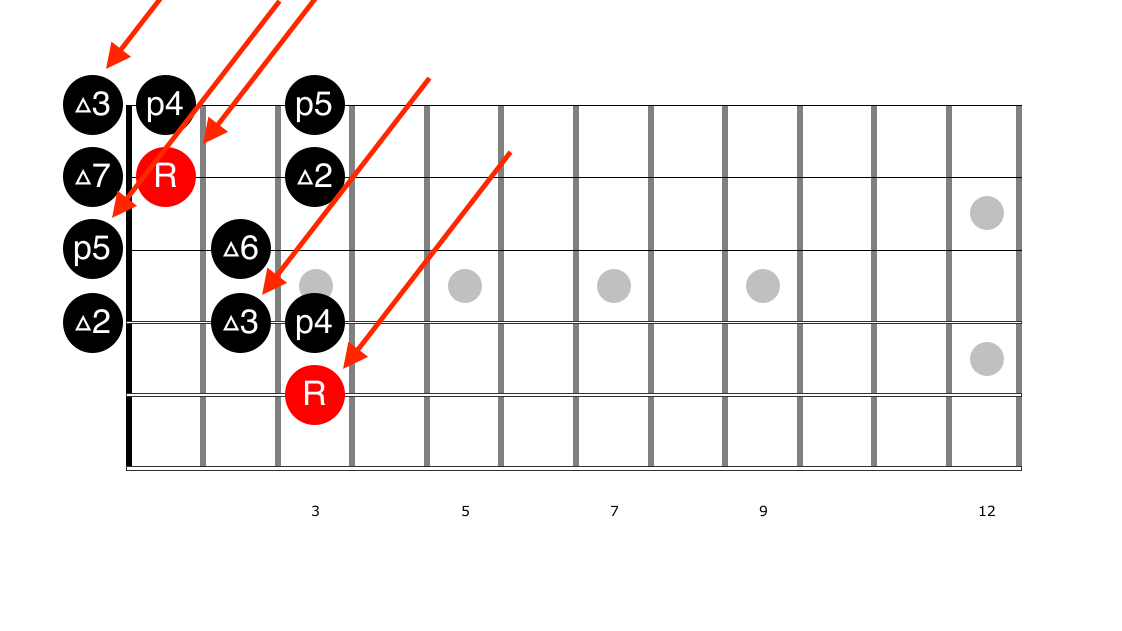
Above: the major scale, with the root, the major third (△3) and the perfect fifth (p5) of the chord marked. Remember where that △3 sits, because we are about to move it.
Three open chords, one finger each
Find the third in the shape, then drop it by one fret:
- E to Em: E major is E–G♯–B. The G♯ is the first fret on the G string. Lift that finger and the open G string gives you E–G–B, which is E minor.
- A to Am: A major is A–C♯–E. The C♯ is the second fret on the B string. Slide that finger to the first fret (a C) and you have A minor.
- D to Dm: D major is D–F♯–A. The F♯ is the second fret on the high E string. Move it to the first fret (an F) and you are in D minor.
If your shape contains the third more than once, every copy has to drop by a fret, otherwise you are playing a major and a minor third at the same time. That is a mood, but not the one you ordered.
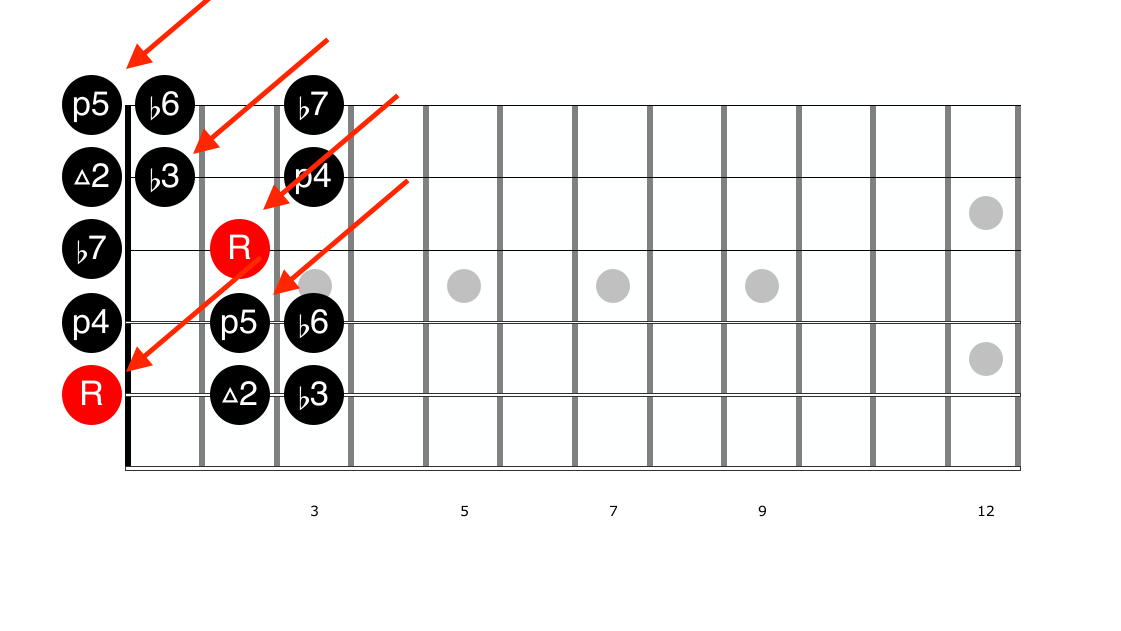
The same idea in minor: this diagram shows A minor, where the third is the flat third (♭3), one fret below the major third you would find in A major. The fifth (p5) is still a perfect fifth.
Why the fifth doesn't care
In both chords the fifth is a perfect fifth, seven semitones above the root. Since it never changes, it is the third that tells your ear whether the chord is major or minor. Major and minor triads are also the two most common triad types in Western classical, popular and traditional music, so this one-fret trick is worth learning properly.
The two-minute drill
- Strum E, then Em, four times each. Say “G♯” and “G” out loud as you move the finger.
- Do the same with A and Am (C♯ to C), then D and Dm (F♯ to F).
- Close your eyes and ask a friend, a partner or a very patient cat to play one of the two. Name which one it was.
The takeaway: don't memorise “Em is a different chord”. Memorise “Em is E with the third a fret lower”. It makes every minor chord you meet afterwards a lot less scary.
Want the full picture?
This is the quick version. The full guide to root, third and fifth, with fretboard diagrams for C and A minor, is here: What is a Chord made of? →