The A minor pentatonic has five notes. The A minor scale has seven. Somewhere between the two, two notes quietly left the building, and nobody sent a search party. Time to find them, because they are exactly the notes that turn “I am running up and down a box” into “I am playing something with a bit of colour”.
This is the focused deep-dive on one detail from my full article Improvisation on Guitar — Part 1 →. If you want the audio examples and the first steps with pentatonic and Ionian, start there.
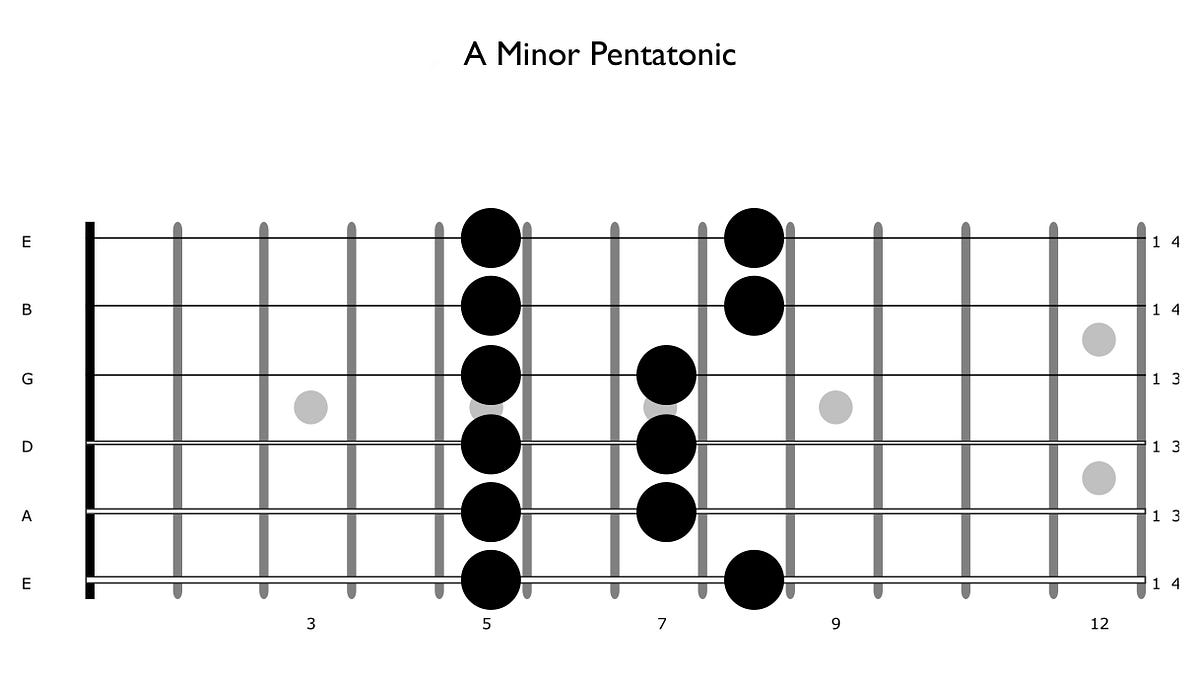
Which five notes are in the A minor pentatonic?
Five: A, C, D, E, G. In numbers that is the root, the minor third, the perfect fourth, the perfect fifth and the minor seventh (1, ♭3, 4, 5, ♭7). It is the same pentatonic scale you know from the box shape, just with the note names spelled out.
The two missing notes: the 2nd and the 6th
The seven-note minor scales have two degrees that the pentatonic skips: the 2nd and the 6th. In A, the 2nd is B. The 6th comes in two flavours, depending on which minor scale you mean:
| Scale | Notes | The 6th |
|---|---|---|
| A minor pentatonic | A C D E G | missing |
| A natural minor | A B C D E F G | F (minor 6th) |
| A Dorian | A B C D E F♯ G | F♯ (major 6th) |
Take either seven-note scale, remove the B and the F (or F♯), and you land on exactly the same five notes. That is why the pentatonic fits inside both of them.
Why the pentatonic feels so safe
Count the gaps between the five notes: A to C is three semitones, C to D two, D to E two, E to G three, G to A two. There is no half step anywhere. The two missing notes are the ones that bring half steps in: B sits a half step below C, and F sits a half step above E (F♯ sits a half step below G). A half step is where a melody starts to lean, so those notes feel more colourful and a little more tense. That is a feature, not a bug.
F or F♯? It depends on the chords
Which sixth you add is not a matter of taste alone, it follows the harmony. The notes of A Dorian are the notes of G major, starting on A, so F♯ often belongs when your Am is the ii chord in G major. The notes of A natural minor are the notes of C major, starting on A, so F often belongs when your Am is the vi chord in C major. Check it against the chords and the melody bar by bar, and let your ears have the final word. This is the same idea I describe at the end of the source article, where C Lydian and A Dorian share the notes of G major.
One takeaway for your next practice session
Put on a static Am chord, then work in four small steps:
- Play only the A minor pentatonic for a minute, up, down and in short phrases.
- Add the B as a passing note between A and C, and then move on to the pentatonic note after it.
- Add the F (or F♯) as a passing note next to E or G, and pick the one that fits the chord you are playing over.
- End your phrases on A, C or E, the notes of the Am chord, so the new notes sound like colour, not like a mistake.
Ten minutes of that and your pentatonic will have two new friends. For the bigger picture on keys, see the minor key and the relative key.
Sources: Applied Guitar Theory, Minor Pentatonic Scale · Notechord, A Dorian · Wikipedia, Dorian mode
If this made your scales a little less boring, you can throw a coffee my way on Patreon — no pressure, purely for the riffs.