Roberto's full guide to improvising with arpeggios and pentatonic scales → walks through the whole method: pick a chord tone, land it on beat one, fill the rest with the pentatonic. Simple on paper — and yet almost everyone who tries it makes one of the same five mistakes. None of them are exotic theory errors. They're all "technically playing the right scale, still sounds lost" problems, and every single one has a one-line fix.
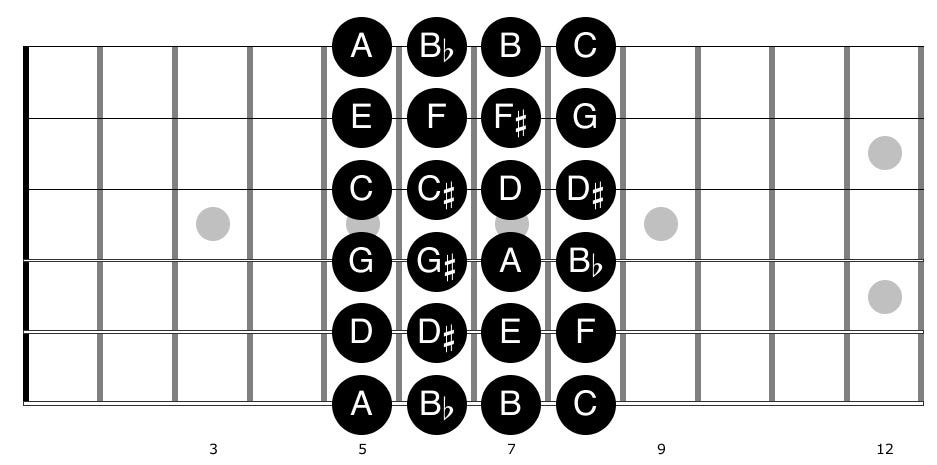
Mistake 1: playing the arpeggio and only the arpeggio
An arpeggio is just a chord's notes played one at a time instead of together, so an arpeggio-only line is technically flawless — it's also the least interesting thing you can play, because you're stating the chord back to the listener instead of saying anything new. Roberto's original point stands: correct and boring are not the same as good. Use the arpeggio for the note that matters (see Mistake 3), not for the whole phrase.
Mistake 2: never touching a chord tone at all
The opposite mistake is just as common: staying inside one pentatonic box for four bars and letting the chords change underneath you without acknowledging it. In jazz-guitar pedagogy this is treated as the difference between "playing the changes" and "playing through the changes" — outlining chord tones on strong beats is what lets a single-note line imply the harmony even without a chordal instrument backing it, a technique guitarist and educator John Hall calls target-tone improvisation. jazz-guitar-licks.com's lesson on target notes and enclosures builds the same idea from the other side: approach a chord tone by a step above or below so the ear hears it arrive, rather than just wandering past it inside a scale.
Mistake 3: putting the target note on the wrong beat
Having the right note somewhere in the bar isn't the same as having it land where it counts. The whole point of target-tone practice is rhythmic placement: the chord tone sits on a strong beat (beat 1, or beat 3 in 4/4), and the pentatonic notes fill the gaps around it. Move the same root, third or fifth to an off-beat and the line stops sounding like it's "about" that chord — it just sounds like a scale run that happens to pass through a good note on the way.
Mistake 4: assuming one pentatonic box covers every chord equally well
Over a I–vi–IV–V progression in C major — C, Am, F, G — the A minor pentatonic (A, C, D, E, G) genuinely works well across all four chords, because A minor is the relative minor of C major and shares most of its notes with the underlying scale. But "works well" is not "works identically": the C triad (C-E-G) and the Am triad (A-C-E) sit entirely inside that pentatonic, all three tones each, while F (F-A-C) and G (G-B-D) only share two of their three chord tones with it — the pentatonic has A and C but not F's own root, and G and D but not G's third, B. Leaning on the same box without checking which notes actually belong to each chord is how a solo drifts from "bluesy" to "just missed the chord." Check the chord tone under your finger before you assume the box has you covered.
Mistake 5: mixing up which mode belongs to which chord
If you switch from pentatonic-only to the "one scale per chord" approach — C Ionian over the C chord, D Dorian over a Dm7, and so on — the modes are not interchangeable labels for "the notes of C major starting somewhere." Each diatonic mode of C major is tied to one specific chord of the progression by its root: Ionian to I, Dorian to ii, Phrygian to iii, Lydian to IV, Mixolydian to V, Aeolian to vi, Locrian to vii°, as laid out in fachords.com's guide to modes and their diatonic chords. Play the F chord's Lydian pattern starting from the C chord's root and you've quietly turned the progression's harmony into a different key in your own head, even though every note you touched was still "in" C major.
None of this replaces Roberto's original walkthrough of the beat-one method → — it just flags the five ways people trip over it in practice. For the underlying scale theory, the seven modes in major and pentatonics on guitar are good next stops, and outside improvisation is where you go once landing on chord tones on purpose gets easy.
If this saved one of your solos from sounding like it wandered in from a different song, you can throw a coffee my way on Patreon — no pressure, purely for the licks.